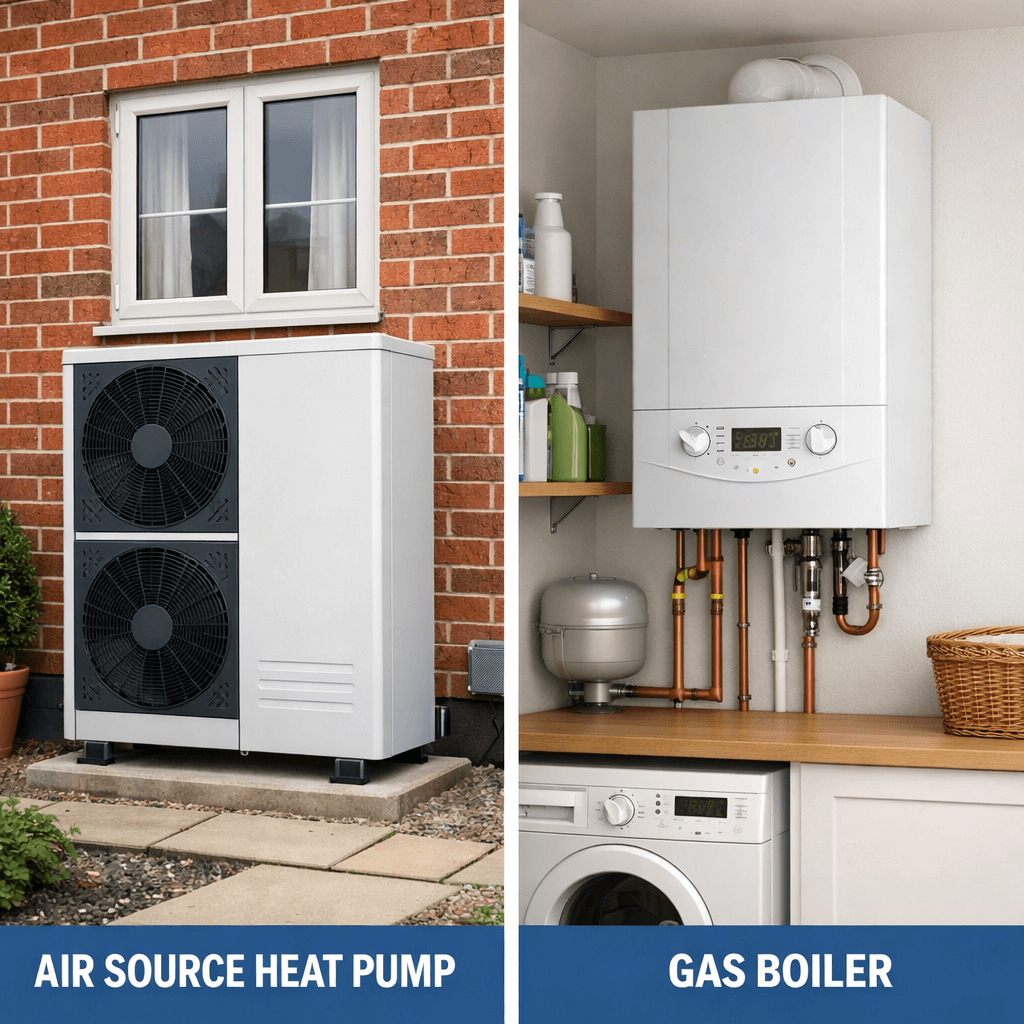
Air Source Heat Pump Versus Gas Boiler – At a Glance

In this post, we’ll break down the key differences and detail between the two systems using insights from Ofgem and the Energy Saving Trust. Before that we take a top level look at the UK energy market.


Energy savingicon

Air Source Heat Pump

Energy Efficiency

2–4x more efficient

Monthly Bills

Lower long-term potential

Upfront Cost

Higher – but £7,500 grant available

Carbon Impact

Low-carbon heating

Works with Solar?

Yes – reduces costs further

Future Ready?

Yes – supports net zero

Existing boiler pipework and flue

Gas Boiler

Energy Efficiency

Less efficient (burns fuel)

Monthly Bills

Lower short-term fuel cost

Upfront Cost

Lower upfront cost

Carbon Impact

High carbon emissions

Works with Solar?

No

Future Ready?

Likely phased out over time

The UK Energy market – at a glance


Wholesale Prices and rising bills
UK commits to Net Zero by 2050
Energy Costs - Electric Versus Gas
UK Government Addresses the Imbalance

Wholesale Prices and rising bills

The UK energy market has changed dramatically in the last few years. Wholesale gas prices surged in 2022–23, and although they’ve stabilised, household bills remain structurally higher than pre-crisis levels. Energy is no longer “cheap and predictable”  it’s a major line item in household budgets.

UK commits to Net Zero by 2050

At the same time, the UK is legally committed to reaching net zero by 2050. Around 60% of UK homes are still heated by gas, and domestic heating accounts for roughly 20% of national carbon emissions. That means the way we heat our homes is under long-term transition whether we like it or not.

Energy Costs – Electric Versus Gas

Currently, according to Ofgem, electricity costs more per unit than gas. This means Air Source Heat Pumps (ASHPs) can appear more expensive to run than gas boilers in some homes particularly if the property is poorly insulated.

UK Government Addresses the Imbalance

However, this price imbalance is widely recognised. The UK government has stated its intention to “rebalance” electricity and gas pricing over time, shifting levies away from electricity to make low-carbon heating more competitive. The long-term aim is clear: heat pumps should be no more expensive to run than gas boilers and ultimately cheaper.

Smart Tariffs

Another important shift? The rise of smart tariffs. Time-of-use pricing, off-peak electricity rates, and smart controls allow homeowners to run heat pumps more efficiently. As flexible tariffs become more common, households can optimise when and how they use electricity significantly reducing running costs.

In short: Gas has historically been cheaper. Electric heating is becoming smarter. Policy and pricing are gradually moving in favour of low-carbon technology.

Cosy Octopus Tariff Structure (March 2026)


Time Window
Rate Name
Typical Rate (p/kWh)
04:00 – 07:00
Cosy Rate
~14.8p
Early morning pre-heat before the day starts.
07:00 – 13:00
Day Rate
~30.2p
Standard variable rate.
13:00 – 16:00
Cosy Rate
~14.8p
Afternoon boost to keep the house warm for evening.
16:00 – 19:00
Peak Rate
~45.4p
Avoid heavy usage; 50% higher than the Day Rate.
19:00 – 22:00
Day Rate
~30.2p
Standard variable rate.
22:00 – 00:00
Cosy Rate
~30.2p
Night-time boost or hot water cylinder heating.
00:00 – 04:00
Day Rate
~30.2p
Standard variable rate.

As one of the UK’s few Octopus Cosy Accredited Installers, Improveasy provides more than just a heating upgrade—we deliver a complete, high-efficiency energy ecosystem. While we install a versatile range of heat pumps, we highly recommend the Cosy Heat Pump for its seamless integration with the Octopus Cosy Smart Tariff.

By pairing world-class technology with Octopus’s specialised “triple-dip” off-peak rates, you can heat your home for a fraction of the cost of a traditional gas boiler.

Note: Pricing and tariff details are accurate as of March 2026. For the most up-to-date rates and full terms, please visit the official Octopus Energy website.

Air source heat pump

What the industry has to say about Air Source Heat Pumps

The Energy Saving Trust highlights that ASHPs are highly efficient systems. They often achieve a Coefficient of Performance (COP) of 3 or more. That means for every unit of electricity used, they generate three units of heat.

By comparison, even the most efficient gas boilers have a COP of less than 1 because they burn fuel to create heat rather than transfer it.

Efficiency is where heat pumps win. The cost equation depends on energy prices but the technology itself is significantly more efficient.

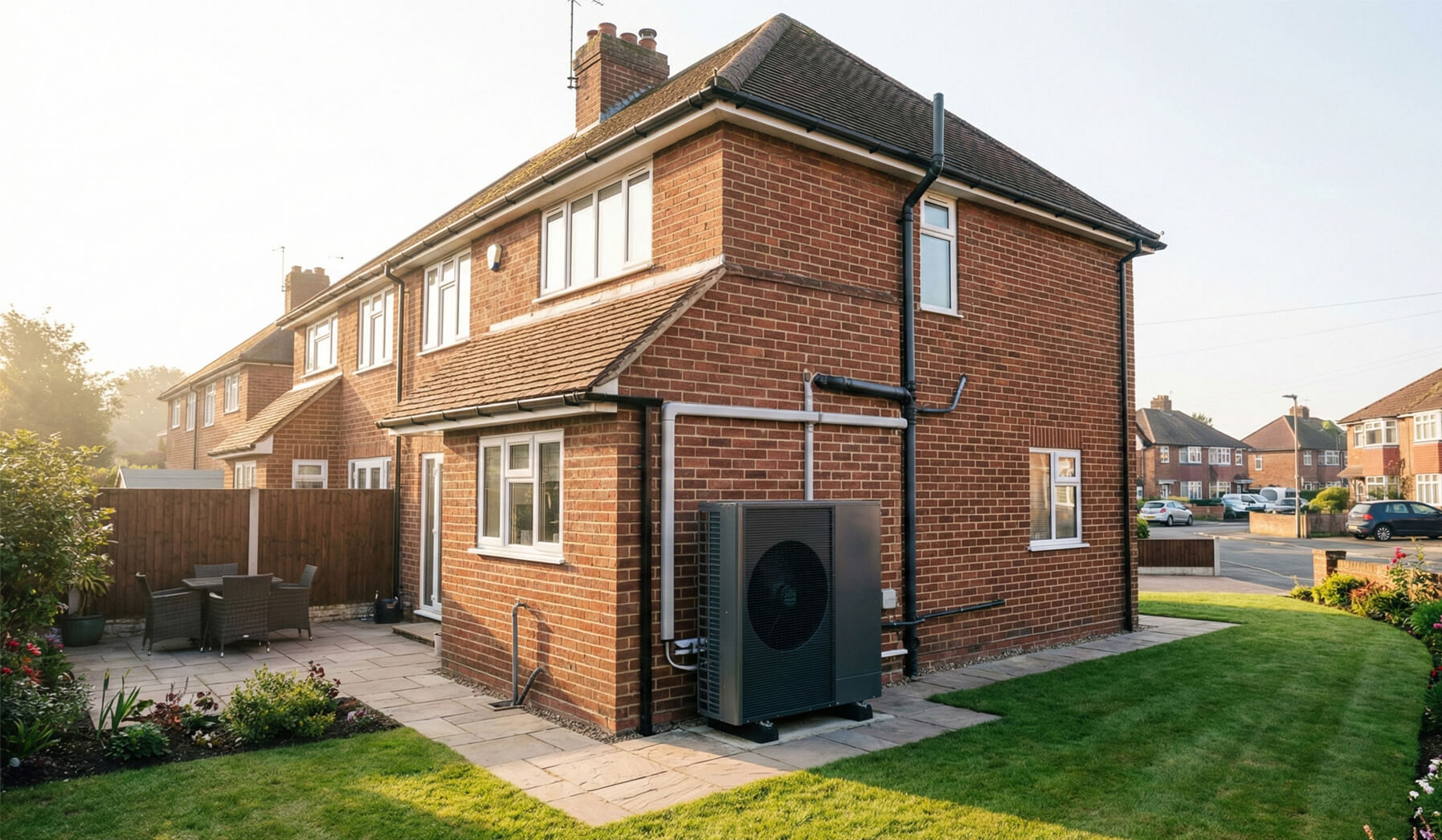
Rear view of UK home with air source heat pump installed under Improveasy Boiler Upgrade Scheme

How Air Source Heat Pumps Work

How a gas boiler works

A gas boiler works by burning natural gas to create heat. That heat passes through a heat exchanger, warming water which is then pumped through your radiators and hot water cylinder (or directly to your taps in a combi system). Even the most efficient models are typically around 90–94% efficient, meaning some energy is always lost through combustion and flue gases. Because they burn fossil fuels, gas boilers also produce carbon dioxide emissions as a direct by-product of operation.

Gas boilers have long been the standard in UK homes. They offer reliable, low-cost heating and hot water. However, they rely on fossil fuels and contribute significantly to carbon emissions.
How a Air Source Heat Pump works

ASHPs extract heat from the outside air, even in cold weather, from temperatures as low as -15°C or -25°C. They use electricity to move that heat into the water in your radiators at your home. While this renewable energy is more energy-efficient, the running costs depend heavily on electricity prices.

Let’s examine the efficiency of the two systems.

Air Source Heat Pump Efficiency vs Gas Boiler (50 MSV – KWD)

While electricity costs more than gas per unit, a heat pump is much more efficient. Its COP is often 300% to 400%, which outcompetes a 90% efficient gas boiler.

The  Energy Saving Trust’s solar calculator shows households can save hundreds of pounds each year on electricity bills. Savings depend on system size, location, and how you use energy. Additionally, you can sell surplus electricity back to the grid through the Smart Export Guarantee (SEG), further offsetting costs.

This combination of ASHPs and solar panels lowers your energy bills and improves your home’s carbon footprint. It’s a strong option for those who want to future-proof their heating system and cut their reliance on fossil fuels.

Improveay easy heat pump vs boiler

Heating System Efficiency Comparison

*COP = Coefficient of Performance. A COP of 3 means 1 unit of electricity produces 3 units of heat.


System Type
How It Produces Heat
Typical Efficiency (COP*)
What This Means in Practice
Key Takeaway
Gas Boiler (A-rated)
Burns gas to create heat
0.85 – 0.95
For every 1 unit of gas used, you get less than 1 unit of usable heat (some energy is lost in combustion).
Efficient for combustion but still loses energy.
Air Source Heat Pump
Transfers heat from outside air into your home
2.5 – 4.0
For every 1 unit of electricity used, you get 2.5–4 units of heat.
2–4x more efficient than gas boilers.
Air Source Heat Pump + Solar PV
Uses self-generated electricity to run the heat pump
3.0+ effective system efficiency
Electricity cost is reduced or partially free during daylight hours.
Dramatically lowers running costs.
Direct Electric Heater
Converts electricity directly into heat
1.0
1 unit of electricity produces 1 unit of heat.
100% efficient but electricity is expensive per unit.

Air Source Heat Pump Vs Gas Boiler Running Cost

Comparison Example (Typical UK Home – 12,000 kWh Heat Demand)

The example below assumes a typical UK home requiring 12,000 kWh of heat per year. Energy prices and performance vary by property, tariff, and location.

* Example price assumptions only – based on recent UK averages.
** Solar assumption: 30% of heat pump electricity supplied directly by solar PV.

Heating System
Efficiency / COP
Energy Needed to Produce 12,000 kWh Heat
Typical Unit Price*
Estimated Annual Running Cost
Gas Boiler (90% efficient)
0.9
13,333 kWh gas
7p per kWh
~£933 per year
Air Source Heat Pump (COP 3)
3.0
4,000 kWh electricity
27p per kWh
~£1,080 per year
Air Source Heat Pump (COP 3.5)
3.5
3,429 kWh electricity
27p per kWh
~£926 per year
ASHP + Solar (30% self-generated electricity)**
3.5
3,429 kWh (1,029 kWh solar / 2,400 kWh grid)
27p per kWh (grid only)
~£648 per year

Summarising running costs

  • A standard gas boiler remains competitive while electricity prices are higher than gas.
  • A well-performing ASHP (COP 3.5 or above) can already match or slightly beat gas running costs.
  • When paired with solar panels, an ASHP can significantly reduce running costs.
  • Future energy price rebalancing could make heat pumps consistently cheaper to run.
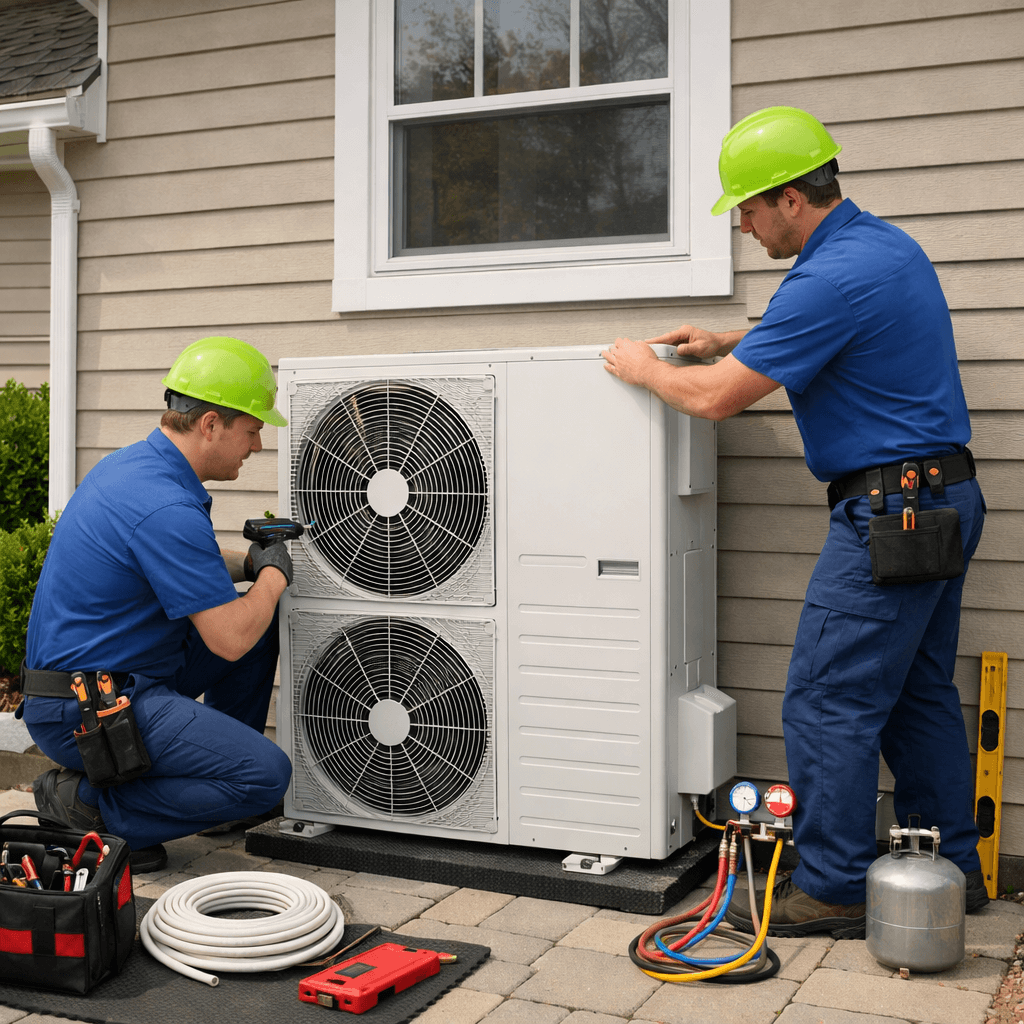
Improveasy staff install an air source heat pump

Factors That Influence ASHP running Costs

Improveasy home insulation

Home insulation

Well-insulated homes retain heat better, reducing the workload on the heat pump.

Improveasy Radiator upgrades icon

Radiator upgrades

Some homes may need larger radiators or underfloor heating to maximise efficiency.

Improveasy electricity tariffs icon

Electricity tariffs

Choosing a heat pump-friendly tariff can significantly reduce costs.

Improveasy Solar panel icon

Solar panels

Making your own power with solar panels can lower ASHP running costs. It helps most during daylight hours and allows you to profit from the Smart Export Guarantee (SEG).

The £7,500 Government Grant in 2026

To support low-carbon heating, the UK government offers the  It provides £7,500 grants for installing air source heat pumps in England and Wales. This significantly reduces the upfront cost and makes heat pumps more accessible to homeowners.

In addition to government support, Improveasy also offers a £500 manufacturer discount on all air source heat pump installations. This further lowers costs and makes switching from a gas boiler to a heat pump more affordable. We also offer flexible finance options, allowing you to spread the cost in a way that suits your budget.

Combined, these incentives can make installation costs closer to a traditional boiler with long-term savings and environmental benefits.

UK Government Boiler Upgrade Scheme £7,500 grant approved for Improveasy customer

Verdict: Is an Air Source Heat Pump Cheaper Than a Conventional Boiler?

While ASHPs may have slightly higher running costs now in some cases, they are still a smart long-term investment.

They are efficient, offer environmental benefits, and their future cost trends also look promising.

As electricity becomes greener and cheaper, heat pumps will likely gain an advantage in saving money.

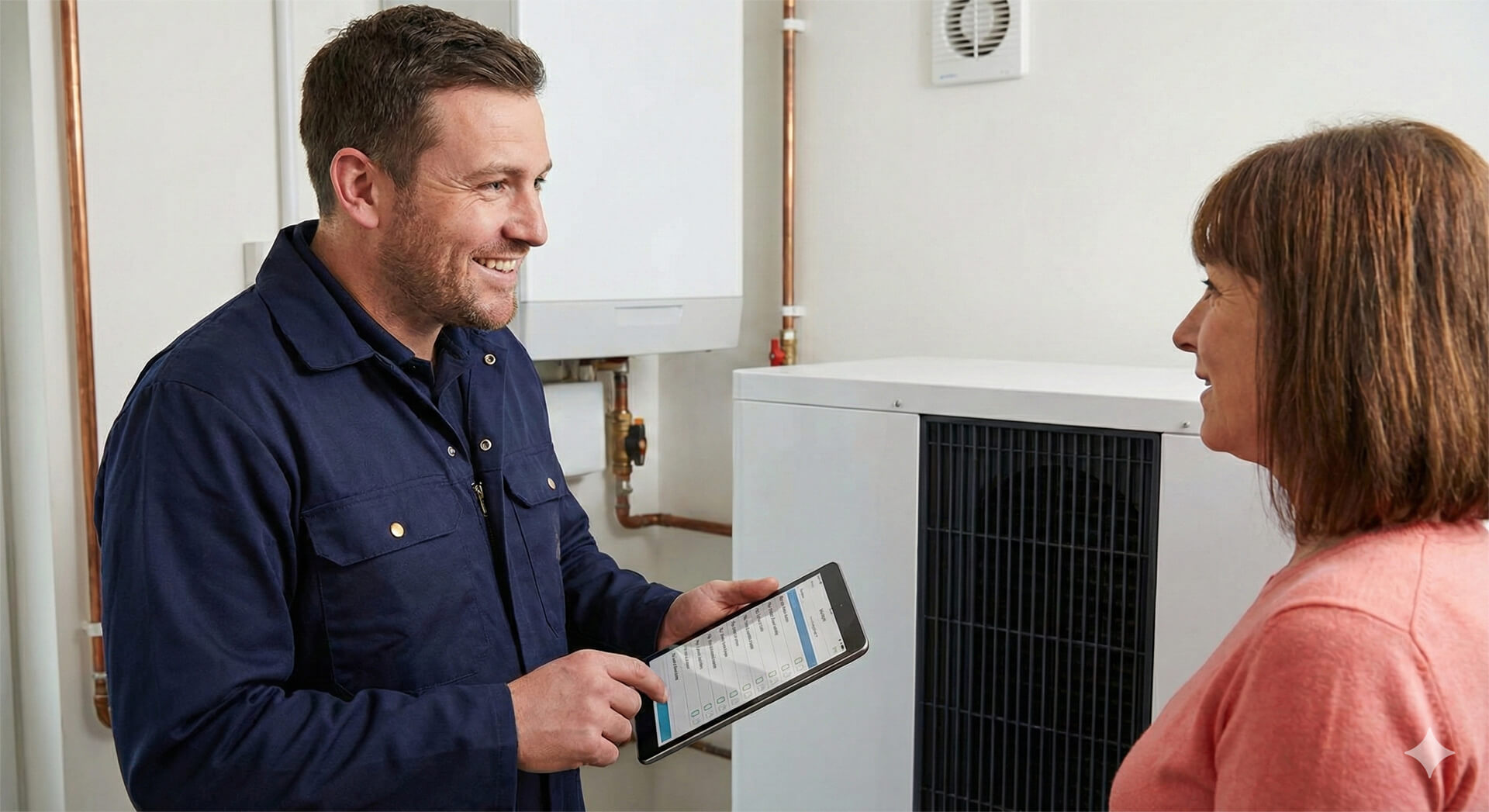
Improveasy engineer talking with a customer